
Amidst the backlash against gender equality and progressive social change, we often talk about the need to not just call men out, but also to call them in. But how do we do that?
The manosphere speaks directly to men and boys’ uncertainties and vulnerabilities, and purports to offer them clear solutions and pathways to stability, community and purpose. Those ‘solutions’ are communicated through narratives and stories which are rooted in hegemonic masculinity, perpetuate patriarchal systems, and often explicitly promote misogyny and sexism. It is vital that we expose and criticise this, actively preventing the spread of harmful ideas. But doing that won’t make men and boys’ needs for stability, community and purpose any less real or pressing. Unless we offer them better narratives to live by, they will keep falling prey to the next waves of manfluencers, ready to exploit their insecurities and fuel their grievances.
We need narratives that provide men with constructive, positive reasons to embrace and build a fair and equal world - and to see that there is a place for them in it, too, and it’s a nice place. Narratives that focus not just on telling them what not to do - but help them understand what to do to live happy, fulfilling lives without harming others. That present inclusion and gender justice as spaces where men can actively thrive, discover meaningful roles, and contribute to their communities. That tie challenging oppressive gender norms and unjust systems with the feelings of freedom, community, hope and achievement.
Systematizing good practice
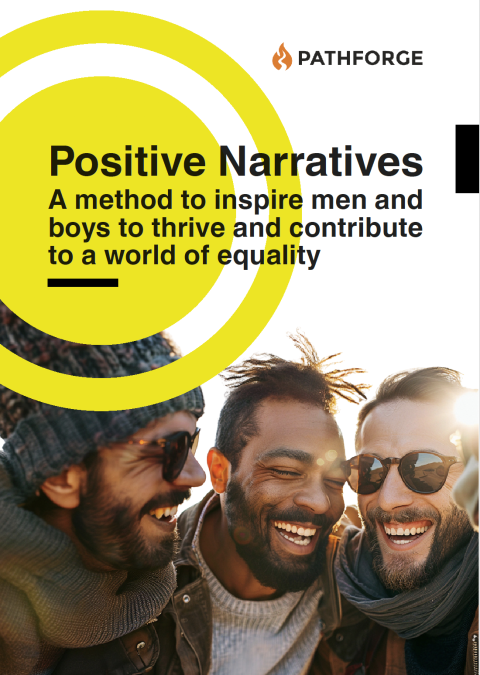
Many practitioners and organizations are already using such positively framed, solution-focused approaches. PathForge, together with a MenEngage Europe working group we facilitate, started to gather, systematise and theorise them in a recent report. The aim is simple: learn from what is already being done and synthesise it into a clear framework which anyone can use to design positively framed narrative-based interventions.
Say, you want to inspire fathers to take parental leave and assume more caring responsibilities in the household. Or challenge schoolboys who believe that they need to be rough with girls because ‘nice guys will always get friend-zoned’. Or you work with men who deeply believe that they should never show emotions. What kinds of narratives might convince them to change their minds?
Our framework outlines eight evidence-based principles for deciding what approach might work best. You can read about it in detail in the report, but broadly speaking, they are about three things:
- Audience, Context, and Expectations: We first need to know whom our narratives are for, how to reach them, and what we can realistically expect of them. No hard-line Manosphere guru will just show up to a feminist conference, and even if he did, he won’t convert overnight. Instead, our narratives should be designed to be engaging to those who are actually open to change - the ‘men in the middle’, the ‘swing voters’ of gender justice. They should meet them where they are - be fun to watch on YouTube, seamlessly woven into games, function in school, work, and locker room contexts. And they need to be realistic as to what the next step for them might be - challenge just enough to inspire change but not so hard as to lead to defensiveness.
- Sticks and Carrots: We then need to balance the incentives. Ample research in psychology of persuasion and education, shows that focusing extensively on moralizing, guilt, or intellectual superiority, is likely to backfire and lead to backlash and resistance. Ostracism and social exclusion are particularly counterproductive sticks - very effective when those excluded have nowhere else to go, but boys and men today do have somewhere to go: the Manosphere. And that’s where they go. Naturally, it is vital to recognise, acknowledge and punish what is morally wrong: discrimination, harm and abuse, in both their individual and systemic forms. There might be times when the stick is the only way. But a lot of the time carrots are much better at inspiring change that lasts longer than the immediate threat of punishment. That’s why our narratives must be fundamentally positive, focusing on aspirational targets and positive reinforcements.
- Constructive and Attractive Design: But what are good carrots that make a narrative resonate with men? We identify three: addressing men’s actual, real-world problems such as isolation or economic precarity, engaging them through emotions rather than arguments, and maintaining an inspiring tone that invites exploration and adventure. Stories that are fun and thrilling will always find a bigger audience than those that are true and morally right, but boring. People are always more interested in stories which are about the problems they care about - especially if they offer solutions. And we can design those stories to make the right solutions feel good: make men proud of being present fathers and respectful partners, good friends, co-workers, and neighbours; focus on the inspiring, rewarding and exciting aspects of building fair systems; link social change and just institutions with hope for a happier, healthier life, and a better tomorrow. Engaging social feelings is particularly vital here: our narratives can show men and boys healthy paths to acceptance, recognition and respect, make them feel encouraged rather than judged, and present being ‘one of us’ as achievable and desirable.
Traction and Global Interest
We have been incredibly encouraged by the response this framework has received. In just a couple months, the Positive Narratives report has seen over 2,000 downloads. It has already been translated into German (thanks to the generous support of the Gunda-Werner-Institut) and several other language translations are currently in progress. It seems pretty clear that many practitioners are searching for these exact kinds of tools. We also hope that it might be useful to anyone who works with men and boys or has a platform which they tune in to.
The Positive Narratives project is conceived as a living framework, meant to evolve alongside our collective practice. We welcome your feedback, insights, and constructive criticism. Working towards gender equality requires picking from a diverse, well-coordinated toolbox, and we hope that positive narratives can be a useful addition to that collection.
We invite you to read the report in detail and help us take this work further:
- Help us build a library of narratives by sharing the narratives you have been using
- Help us test the effectiveness of specific narratives
- Help us adapt narratives and the entire framework to your cultural context
Resisting the backlash and building a better tomorrow is hard, but with the right tools and a joint strategy, we can do it.
Let's shift the narrative, together.