
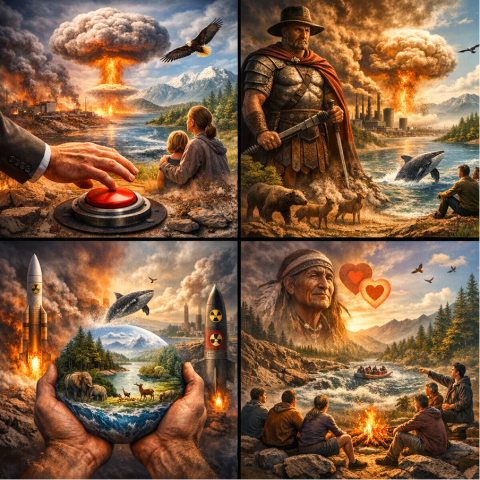
Many years ago a troubling thought began rattling around in my head. What happens when an outdated patriarchal mindset meets nuclear weapons?
That question would not leave me alone. So in 2007 I wrote a small booklet called Sustainable Masculinity. It was nothing grand, just a thin 30-page booklet exploring a simple but uncomfortable idea.
I’d realised that the old patriarchal rule book that has guided male behaviour for centuries was written long before humanity invented weapons capable of wiping out civilisation. And the two may not coexist for very long.
For thousands of years the old code has whispered the same instructions into the ears of boys and young men.
Dominate, control, win, and never-ever back down. Those ideas may once have helped tribes survive. But in a world armed with nuclear weapons, ecological strain and industrial scale destruction of nature, the same mindset begins to look dangerously outdated.
That was when a different question began forming in my mind. What if masculinity itself needs to become sustainable? The more I thought about it, the more the pattern appeared.
The patriarchal script that encourages men to dominate women is reflected in how humans treat the Earth.
Control and Dominate! Control the land, the animals, the rivers, and extract the resources with no thought of tomorrow.
Under patriarchy, Mother Earth quietly becomes something to conquer.
Yet anyone who spends time outdoors knows a different way to relate to nature. Years ago I spent many seasons guiding young people down wild rivers in southern Oregon. On one very memorable trip, twenty teenage boys from a youth detention centre joined me and my hand-picked river guides for a 14-day journey that changed us all for ever.
The river had a way of teaching lessons that no lecture ever could. A river does not respond well to domination. Try to overpower it and the current flips your raft upside down. Paddles go flying, boys go swimming, and egos take a sudden dip in cold water.
But work with the river, read its currents, feel its rhythm, and suddenly the boat glides through rapids that looked terrifying only moments earlier. Paddling is a well-coordinated team that’s partnership and nature seems to prefer it.
Around the campfire at night the conversation often turned to what masculine strength really means. The boys would arrive with the usual ideas. Be tough, fearless, in charge, and never show weakness.
But after a few days on the river something would begin to soften. The boys would watch guides helping each other when a raft flipped or when carrying heavy equipment over rocky terrain. They would see how teamwork enabled the group to successfully navigate a challenging and dangerous rapid. They would notice that survival in wild country depended more on cooperation than domination. Slowly new thoughts would surface. Perhaps strength also includes care and courage includes respect. Perhaps leadership sometimes means protecting rather than conquering.
Around that time I came across the work of social systems thinker, Riane Eisler, who described two broad ways societies organise themselves. Dominator systems and partnership systems. Dominator cultures rely on power over others. Partnership cultures rely on cooperation and mutual respect.
When I first read her work it was as if she had described something I had been seeing on rivers for years. Partnership systems made a lot of sense to me. For example; I knew that the planet we live on is not simply a warehouse of resources.
Just stand on a headland and watch a whale breach offshore or a pod of dolphins surfing a wave for the joy of it. Walk quietly through a forest where the air smells alive. You begin to realise that this extraordinary planet is not an opponent to conquer or an endless resource to consume. It is a living home that has given us everything. Water, food, air, and beauty. And of course; it provides the remarkable opportunity for life to flourish.
A few years later, Riane Eisler’s partnership model became obvious to me in a different setting. It changed the way I would respect women for ever.
I had attended a sweat lodge ceremony with a Native American elder along the Klamath River; the same river where many of my multi-day raft trips took place. During the intense heat and discomfort of the sweat lodge, the elder almost sang some words that stayed with me for ever. He smiled gently at a pregnant woman sitting in the oppressive heat and said, “Ho to the one who beats with two hearts.”
Everyone in the circle nodded with quiet respect as these simple words touched home. He had reminded us that the woman who was sweating with us carried two beating hearts within her. His honouring of pregnancy was so simple; yet so profound. Later it occurred to me that the Moter Earth is like that too. Every day this planet beats with trillions of hearts. Whales in the ocean, birds singing in the forest and human hearts in every village and city.
The difference is this. Due to technological and scientific advances, we humans now hold enormous power and have the power to either nurture those beating hearts or to destroy them.
That is why my new concept of ManGood matters to me. It is not about weakening men. It is about expanding what strength means. A ‘ManGood Man’ can still be courageous and decisive. But he also understands that domination is not the only way to live.
He protects what is precious; respects women and the respects the living world. The ManGood Man knows that partnership, not domination, may be the key to humanity's long-term survival.
Ancient Manbox Code
The old manbox code says conquer the land,
be toughest bloke in the tribe or the band.
Dominate rivals, take what you can,
prove you are king of the hill or the clan.
But mix that code with missiles and might,
and suddenly power looks less like right.
A world full of weapons and prideful men
play those dangerous games we can never win.
Yet whales still rise and dolphins still spin,
reminding us of the miracle we’re in.
This planet is home, not prize to control,
a living blue jewel with heart and with soul.
Ho to the Earth with her trillions of hearts,
life within life in forests and parts.
ManGood men hear that rhythm and start
living with care for the planet's great heart.
My short quirker (zany rhyme) brings us back to the river where we are immersed in nature’s heart.
A river guide learns quickly that domination is useless in moving water. Try to overpower the current and it throws you into a rock or a cliff. Work with the current and the river carries you safely. When river guides scout a challenging rapid we stand on the shore and discuss the best ‘lines’ through the seemingly chaotic white-water. They are there if you are skilled or experienced enough to see them. We try to follow these lines for the safest route through the rapids.
Humanity may be wallowing in a similar rapid right now. The old dominator mindset has carried us to a dangerous bend in the river of history. Nuclear weapons proliferate and ecosystems are under strain. The planet that feeds us is asking for a different relationship.
The encouraging news is that like the lads on my river trips many males can open to new ideas; especially when they experience them directly. Give them movement, adventure, laughter and honest conversation around a campfire, and the old Man Box rules begin to wobble. Something wiser can grow. They begin to see that leadership protects life rather than dominating it. My rap-style quirker mimics what I’ve seen around countless campfires.
When the Man Box Wobbles
So we laugh, we wobble, we act a bit strange,
and quietly, something inside us can change.
From silliness, a new way arises,
as laughter loosens our man box guises.
And when that understanding begins to spread, a more sustainable masculinity becomes possible. One that works with the living world rather than against it. Because in the end the goal is not simply to become better men. The goal is a future where humanity learns to live well on this astonishing blue planet.
A planet where whales still breach in the ocean, forests breathe quietly in the wind, and boys grow into men who understand that strength and care belong in the same human heart.
Perhaps the real test of ManGood is simple.
Will the human heart learn to beat in rhythm with the many hearts of the Earth?
Ho!