
Part 1: How the rise of lady-workers affected economics, employment, and inflation
Jan 14, 2026
One of my New Year’s resolutions is not to get into dumb beefs with people online, because I have a bad habit of getting cranky or bored, especially when I’ve got an overdue work project that I really don’t want to tackle, and hitting up the internet to go argue. In fourth grade my best friend Sarah Hammond and I had an Arguing Booth where we’d try to convince people to pay a dollar to argue with us. We’d offer up such spicy topics as the death penalty, free will, gay marriage, and flag-burning (it was the ‘90s). Unfortunately, the booth rarely made money. We had very few customers, so we usually just argued with each other.
That said, argumentative beefs can occasionally be illuminating, because they force everyone to clarify their positions and even learn something new. I had a long back-and-forth a few weeks ago with a character called Rohan Ghostwind, who, from his pseudonym, I picture looking like one of these guys. The conversation started with the broad question of whether feminism has been bad for men.
I think this is an interesting question, and I’m going to try and grapple with it in this essay.
First, I’ll acknowledge that feminist readers will likely be annoyed that this is even a conversation. Men ran the world for thousands of years, a few tables turn, and now men are victims? While recognizing this perspective, I think it’s still worth engaging with this debate, because many men (and some women) think that feminism has been bad news for men, and those folks are leading the charge to roll back women’s progress. Among Gen Z, 59% of males believe that “men are being expected to do too much to support equality,” and 57% per cent of males think “we have gone so far in promoting women's equality that we are discriminating against men.” If you don’t have my zeal for getting mad and wasting time online, I caution you to stay away from the #Repealthe19th hashtag and the marital rape enthusiasts on Twitter.
Anti-feminists have also claimed real power within the current administration. Scott Yenor, who directs The Heritage Foundation’s Center for American Studies, has argued that employers should be legally allowed to discriminate against women in the workplace, for example “to support traditional family life by hiring only male heads of households, or by paying a family wage.”He also believes that “governments should be allowed to prepare men for leadership and responsible provision, while preparing women for domestic management and family care.” Heritage is the architect of Project 2025, the guiding document for the Trump administration’s domestic policy agenda.
In this mini-series, I’ll address three claims about how feminism has hurt men: first, in terms of economics and employment; second, in terms of marriage and family formation; third, in terms of education and anti-male cultural biases. Because I’m long-winded, I’m going to focus this essay on the first set of economic claims, and save the second two claims for my next newsletter.
Before I get into my arguments, I’ll lay out some priors. I’ll start by providing a definition of feminism. I’ll next define patriarchy and provide examples of how it works in practice. Finally, I’ll address some specific claims about how feminism may have hurt men. I will acknowledge right up front that I consider myself a left-leaning feminist. But I’m going to try to do this fairly and stay open-minded to problems with the feminist position. Commenters are welcome to point out arguments that I’ve missed.
WHAT IS FEMINISM?
Marie Shear wrote, “Feminism is the radical notion that women are people.” I’ve used the complementary definition “Feminism is the belief that women are full-fledged people with internality, inherent worth, and the right to live with agency, access equal opportunities, and make their own choices.” The Oxford Dictionary uses “Advocacy of equality of the sexes and the establishment of the political, social, and economic rights of the female sex” as its working definition. The full human rights of women are the throughline here. Another way to describe feminism is as a movement dedicated to the overturning of patriarchy, which brings me to:
WHAT IS PATRIARCHY?
Patriarchy, in turn, is described by Wikipedia as “a social system in which positions of authority are primarily held by men.” In my back-and-forth with Mr. Ghostwind, I defined it thusly: “Patriarchy is a system within which greater power, status, and freedom is afforded to men solely by virtue of their gender.” This last point is important: Patriarchy is not simply a meritocracy where benefits naturally accrue to men, it is a system that ensures that power flows to men because they are male. What does this mean in practice? Across history and cultures, patriarchal societies have often featured some combination of the following:
Patrilineal inheritance: One’s title, office, or property is passed solely through male heirs. Daughters do not inherit family wealth or status and can only access wealth and status through marriage. May mean that sons are preferred to daughters.
Laws dictating male ownership of wives: These include the law of coverture, which states that marital property is only held by the husband and married women have no property rights of their own; lack of prosecution of marital rape and spousal abuse; laws that women needed a husband’s permission to travel, open a credit card, or obtain contraception;
Prohibitions on women’s political participation: Only men are allowed to vote, run for office, or hold elected office.
Prohibitions on women’s education: Women are not taught to read or permitted to go to school; women are barred from colleges, universities, and libraries.
Prohibitions on women’s professional roles: Women are barred from certain professions (such as medicine, law, academia, business) and professional societies.
Prohibitions on women’s freedom of expression or movement: Women are not allowed to speak in public or publish their writing without using a pseudonym, are prohibited from driving or traveling to certain places, or are sequestered in specific places when menstruating or pregnant.
Patriarchy has many other downstream effects on how we understand and value gender roles and attributes, but these examples are a good concrete starting place in terms of understanding the constraints of patriarchal societies on women’s “right to live with agency, access equal opportunities, and make their own choices.”
Feminism has been an enormously successful global movement over the last 150 years, in the sense that many of these examples of patriarchy-in-action were commonplace before feminism and would strike us as odd and antiquated in most contemporary societies today.
Still, feminism has suffered from persistent image problems. The very first suffragettes were called angry, man-hating “hyenas in petticoats” for demanding the vote, and the claim that feminists are anti-male has persisted ever since. Girlboss Taylor Swift sums this up well: “As a teenager, I didn’t understand that saying you’re a feminist is just saying that you hope women and men will have equal rights and equal opportunities…What it seemed to me, the way it was phrased in society, was that you hate men…For so long it’s been made to seem like something where you’d picket against the opposite sex, whereas it’s not about that at all.”
Even though most feminists throughout history have been wives of men, mothers of men, and colleagues of men, the idea that feminists are “picketing against the opposite sex” rather than for their own human rights has been a constant theme. But have feminists actually operated at men’s expense?
Claim 1: Feminism has hurt men economically because women’s entry into the workforce has taken jobs away from men.
This claim has a straightforward logic to it - in theory, more jobs going to women mean fewer jobs for men - but is complicated to unpack, because a number of other economic shifts coincided with the entry of women into the workforce, like rising automation, the transition from a manufacturing to a service economy, globalization and the outsourcing of factory jobs overseas, and the crumbling of the labor movement amidst the rise of right-to-work policies. Moreover, this claim suffers from a fixed-pie fallacy: the assumption that there are a finite number of jobs to go around, as opposed to the reality that economies can grow. As Jerusalem Demsas has written, this kind of zero-sum thinking is a form of peasant logic, characteristic of pre-industrial societies. In fact, there’s clear data suggesting that in the decades after women joined the workforce, economic output increased and our societal living standards improved. Compared to the prototypical 1950s family, we live in larger homes, own more vehicles, travel more, and enjoy more creature comforts today. Compared to more patriarchal countries with much lower female workforce participation, we live in the lap of luxury. The countries with the fewest working women are Yemen, Afghanistan, Iraq, and Syria, and I doubt that even the most strident anti-feminists would like to live within their economies. Indeed, an International Monetary Fund report suggests that closing male-female gender employment gaps grows the GDP, in part because gender diversity facilitates innovation: “Increasing women’s employment boosts growth and incomes more than previously estimated, exceeding the improvement that comes simply from adding workers. Among countries where gaps in participation rates are the largest, closing them adds 35 percent to GDP, on average.”
Men as well as women have benefited from the job growth and economic expansion that has occurred since women went to work en masse. As a report from the conservative Cato Institute states, “From 1962 to 2024, males between ages 25 and 44 saw real income growth of around 45%. Even the idea that real hourly earnings for the typical 25- to 54-year-old male with only a high school diploma fell depends entirely on measuring income from the middle of the 1970s.”
Even if you use that middle-of-the-1970s metric, the real economic story in the U.S. in the last 50 years has been shaped like K: men in the highest earning bracket are richer than ever before, whereas men in the bottom 50% for education have seen declining prospects (and also have the lowest marriage and family formation rates). It’s hard to pin this on working women, most of whom are not in the same occupations as blue collar men, instead of the aforementioned economic shifts (automation, declining union participation, outsourcing) and several decades of rising economic inequality and corporate consolidation.
It’s also not even clear that “feminism” is the reason women went to work in the first place. As historian Stephanie Coontz has written, the 1950s were an ahistorical blip, since the postwar boom allowed families to survive on a single income. Before the industrial revolution, most families practiced subsistence farming (and long before that, foraging), and women contributed essential labor and calories. There’s nothing new about women working for material reward. Women joined the post-industrial workforce in large numbers starting in the 1960s because labor-saving household technologies opened up more time, and the changing nature of work meant that physical strength and endurance were no longer needed to perform most jobs. Second-wave feminism was as much a consequence of those shifts as a driver of them.
But what about anti-male DEI?
As I was drafting this essay, the writer Jacob Savage published an article in the magazine Compact, The Lost Generation, that quickly went viral. Savage describes his frustrated attempts to break into TV writing in the 2010s, discovering that writer’s rooms were eager to “diversify” and not willing to hire white men. He cites other data suggesting that within the same time span, fields like publishing, journalism, and academia went from being dominated by white men to deliberately excluding them. This piece has stoked debate: Matt Bruenig looked at census data, finding that white male employment remained steady during the time period Savage focuses on, including at upper income levels and within arts and entertainment fields.1 However, Noah Smith is unconvinced by Bruenig’s evidence, arguing that aggregate group data cannot tell us about individual experiences of discrimination.
Personally, I think Savage’s piece is very good, well-researched, and worth taking seriously. It comports with anecdata from my own friends in the entertainment industry. Savage is likely correct that within some industries, like entertainment, journalism, publishing, and academia, efforts to correct for existing gender imbalances led to discrimination against men. I think this is bad. I also think it’s possible for two things to be true; it was bad that women were shut out of these professions in previous generations,2 and it is also bad that men were shut out of them in recent decades. There are generational as well as gendered forces at play, too. Many of the senior-level executives making hiring decisions were themselves white men, who continued to occupy the highest ranks of their industries even as they tipped the scales against young men seeking to enter them. Efforts to correct white male dominance therefore had a uniquely chilling effect on younger generations while allowing Boomer men to continue sitting atop corporate hierarchies.
Of course, diversity hiring isn’t the only reason that media and academic jobs dried up for young men in the 2010s; amidst elite overproduction and gerontocracy, the financial and cultural power of these industries was shrinking too. Reading Savage’s essay, I was reminded of a recent New York Times story, “The Gen X Career Meltdown.” In Savage’s account, Gen X white men are the winners, occupying the roles that closed to millennial men in the 2010s. They are the showrunners, the directors, and the department chairs who got all the good jobs before the millennials came on the scene. But, as the NYT reports, “If you entered media or image-making in the ’90s — magazine publishing, newspaper journalism, photography, graphic design, advertising, music, film, TV — there’s a good chance that you are now doing something else for work. That’s because those industries have shrunk or transformed themselves radically, shutting out those whose skills were once in high demand.” In other words, maybe the Gen Xers didn’t fare so well either, because technology and austerity took over these creative industries. As always, we can blame the boomers for screwing everything up.
Still, my takeaway is that Savage is basically correct that unfair discrimination happened. I think that the pendulum needed to swing, but it swung too quickly and too hard; from overt sexism and the exclusion of talented women, to discrimination against a generation of talented young men. The pendulum is already swinging back, and I don’t believe that most women actually want to work in totally female-dominated industries (I certainly don’t!) any more than they want to go to all-female colleges. Indeed, now that university admissions offices are practicing pro-male affirmative action, it’s harder to get into an elite college if you are female. Male applicants can now take spots away from female peers with higher stats. There’s even anthropological evidence that when women get power, they are more likely to share it with men than to hoard it for their own gender. My hunch is that the pendulum will land in the territory of relative gender balance when the dust settles.
But what about inflation?
As reviewed, there’s little evidence that women’s entry in the workforce dramatically affected men’s employment or earning prospects. But what if having more workers devalued everyone’s wages? According to this argument, the presence of women in the workforce drives up inflation, making it impossible for families to survive on a single income. Indeed, there is a large economic gulf between single-earner and dual-earner families; as Matt Bruenig writes in Jacobin, “In 1963, a family surviving solely off a median married man’s wage would have an income that was 81 percent of the median family income. In 2024, such a family would have an income that is just 55 percent of the median family income.” However, that’s not because of falling standards for single-earners, but rather the rising wealth of dual-earners.
As Matthew Yglesias writes, “This model of household has declined not because people have gotten poorer but because they’ve become less poor. What’s gone up is not the cost of living relative to a single earner’s wages, but the opportunity cost of the second adult not working. Nothing is stopping a typical married American couple from accepting 1960s material conditions in exchange for one parent being a full-time homemaker. It’s just that most people don’t want that.”
Looking across countries, there is no direct link between women’s workforce participation and higher inflation. If anything, the evidence seems to point in the opposite directions: women’s employment is associated with better macroeconomic stability, and lower inflationary pressure, not higher. That’s because prices rise when demand exceeds supply, and working women increase supply more than demand. That is, when we add workers we raise output, and these output gains outpace rising household income and consumption. Larger labor pools also reduce bottlenecks, which can dampen wage–price spirals.
Globally, countries with high and stable women’s workforce participation, like the Nordic countries, the Netherlands, Canada, and Germany, have not shown notably higher inflation, historically, than places like Southern Europe, East Asia, and the U.S. where women either participate less in the workforce, have entered the workforce in more recent decades, or tend to leave the workforce after motherhood.
In the 1990s-2010s, as women’s workforce participation grew to its current level, inflation actually fell, leading to protracted macroeconomic stability (the “Great Moderation.”) Moreover, women’s employment is highest in sectors like education, healthcare, clerical and professional services, and public services. These sectors are typically less inflationary, often have fixed pricing (or create publicly available services, like K-12 schools), and don’t generate wage–price spirals like commodity or construction booms. So if anything, working women are less of a problem for inflation than your typical finance or tech bros.
However! What if the greater female economic participation spurred by feminism, even if it’s made us richer and more macroeconomically resilient, has actually degraded us culturally, by devaluing the important work of homemaking and childrearing, suppressing marriage and the birth rate, convincing boys that they are toxic and unwelcome at school, and creating a lonelier, more transactional, more spiritually deprived world? Glad you asked! I will tackle these questions next, so tune in.
In the meantime, if you see anyone arguing on here or X that feminism has hurt men economically by taking jobs from men, promoting discriminatory hiring, or driving up inflation, please point them here and then tell them to go argue with me in the comments.
Part II: Has feminism weakened the family and crushed the birth rate?
Jan 21, 2026
Welcome back to my mini-series on feminism and its effects on men. In Part I, I unpacked whether women’s participation in the workforce has damaged men’s economic standing in terms of their wages, employment prospects, DEI, and the effects of two-earner couples on inflation. I also defined the terms “feminism” and “patriarchy” to prevent any shenanigans. In this essay, I’ll move on from economics and talk about culture: the effects of feminism on marriage and family formation. This is Part II in a three-part series. The last installment will tackle boy’s educational attainment, mental health, and “toxic masculinity” discourse.
First, some updates! Does anyone remember the 1990s trend, Glamour Shots? These were huge when I was in high school. You’d go to the mall, get a pancake-makeup makeover with a full can of hairspray, and get a bunch of soft-focus, Vaseline-on-the-camera-lens style pictures of yourself. Being a nerd and a snob, I was deeply opposed to Glamour Shots, and my inner monologue would occasionally mutter, uncharitably, that they were a bit “mutton-dressed-as-lamb,” if you know what I mean.
Anyway, this is a long-winded way of saying that I got muttony new Glamour Shots1 in the lead-up to my book launch, and a new website to boot. My super-talented friend Andrea designed it and you can hire her for your own projects!
Back to feminism: Let’s unpack some arguments!
Claim: Feminism has led women to abandon marriage and family, lowering the birth rate, making it harder for men to find wives and damaging our overall social fabric.
In the pre-feminist days, marriage was an imperative for women who wanted a place in society. Being an old maid meant little freedom, dependency on one’s father or brother, and possible destitution and a life of servitude (or perhaps the nunnery). Generations of women were taught that motherhood was their main purpose on earth, and women who did not want children were perverse weirdos. Feminism has enabled women to choose different paths. When it comes to personal liberty and freedom, having more choices is a good thing. But in the aggregate, increasing choice while removing stigma can shift cultural frames in ways that disincentivize marriage and family formation altogether. Indeed, some feminist voices have overcorrected for previous children-are-your-only-calling messaging by portraying motherhood as constraining and lame (I wrote about this here). I was no fan of a recent viral Jameela Jamil essay about her dislike of children; I don’t see this type of rhetoric as feminist, but as anti-human.
Is feminism the main culprit behind anti-family cultural attitudes and tumbling birth rates, though? We can look across historical time and across cultures to find the answer. We know that birth rates have fallen globally within the last century. It’s a common refrain that feminism caused low birth rates in industrialized societies by encouraging women to abandon their families in favor of sluttish personal freedoms, wasteful education, and email jobs. However, the main driver behind falling birthrates is actually good news: our infant mortality rates are dramatically lower now that at any time in history, so we no longer need to produce large broods in order to fulfill our fertility intentions. Moreover, when economies shifted away from agriculture and small family businesses, we lost the economic imperative to breed children as mini-employees who could contribute to the work of the farm or the shop. Individual families continue to bear the costs of childrearing, but the benefits of childrearing now accrue more to the larger society than to individual families.
Last week, I mentioned Yemen, Afghanistan, Iraq, and Syria as the countries with the lowest female workforce participation, and the birth rate is actually falling most steeply in those countries, none of them hotbeds of feminism. Perhaps counterintuitively, among industrialized democracies, fertility is highest among the countries with the highest labor force participation by women.
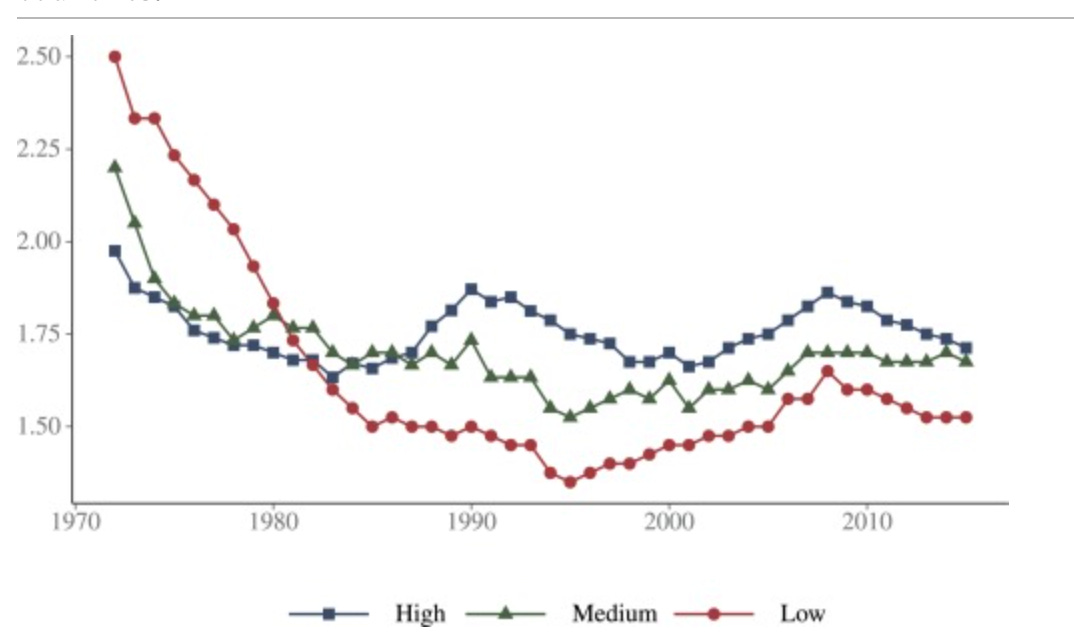
High female labor force participation (FLFP) countries (blue line) include Canada, Denmark, Finland, Great Britain, Norway, Sweden, USA, and Switzerland. Medium FLFP countries include Austria, Australia, France, and Germany. Low FLFP countries include Belgium, Italy, Netherlands, and Spain. Source: Doepke et al., 2023
We see similar trends with women’s education. Contrary to what’s been alleged by many conservatives in the U.S., overeducated women are not the culprit behind tumbling birth rates. Indeed, the relationship between education and fertility has flipped in recent decades, such that the most educated women are having the most kids (and getting married at the highest rates, too).
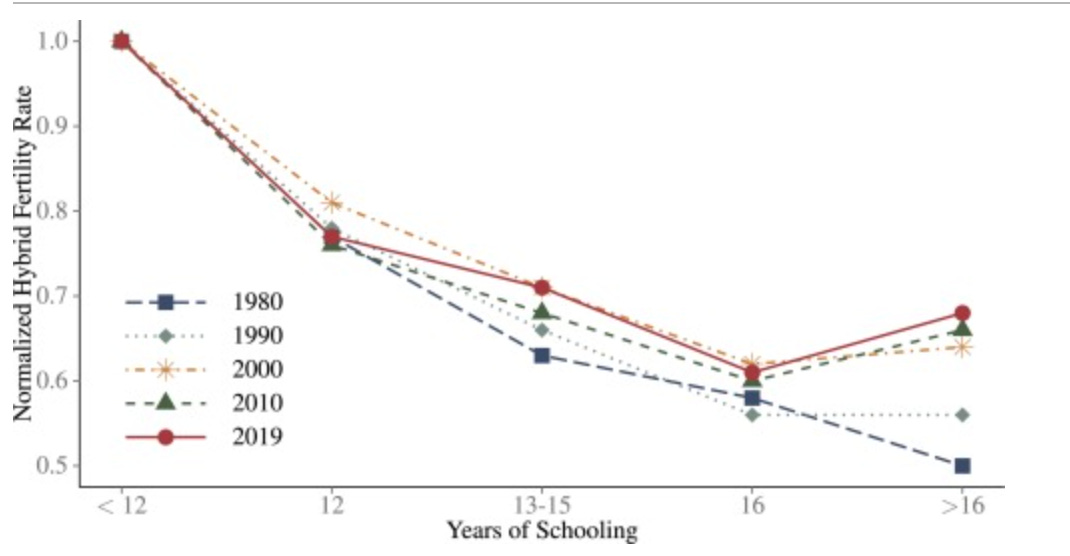
U.S. data. Source: Doepke et al., 2023
The places where the birth rate is reaching the most alarming lows are not historical strongholds of feminism. Take South Korea. It has the lowest birth rates in the world. Unlike the U.S. and Western Europe, where there is more than a century-long tradition of feminist influence, South Korean culture is not steeped in strong gender-equity ideals. Indeed, it is known for sexist, rigidly hierarchical workplaces and husbands who are overworked and reluctant to contribute to housework and childcare.2 The problem in South Korea is not an excess of feminism, it’s that feminism hasn’t gone far enough. Women have high workplace participation, but their low representation in political and corporate leadership means that public policies and family cultures aren’t built to accommodate work and motherhood.
Other recent evidence suggests that male contributions to housework and parenting are a good predictor of birth rates in developed countries, suggesting that we need a feminism that expands to the home front as well as the corner office. Claudia Goldin won a Nobel Prize for making this argument. Indeed, a study of compulsory paternity leave in South Korea found that it increased births by a whopping 15%.
As another example, a new research paper by the economist Abigail Dow found that higher childcare prices in the U.S. reduce birth rates, delay first births, and lengthen the interval between first and second births. A 10% increase in the price of childcare decreases in the birth rate by 5.7%.
To oversimplify wildly, I’d say that if your number one goal is to optimize for birth rates, you either want no feminism (low female workforce participation, traditional gender attitudes), or a lot of feminism (high female workforce participation coupled with high political representation and high egalitarianism). No feminism will bring (force?) many women into motherhood, but entails significant economic and cultural trade-offs that most people in industrialized societies do not want. A lot of feminism means you’re living in a society that accommodates working mothers, has a strong public policy infrastructure to support families, and has social attitudes that promote men’s involvement in care. The least optimal situation is some feminism: enough feminism so that women get degrees and go to work, but not enough feminism to change work cultures and men’s attitudes to make marriage and motherhood a better trade-off for women. Societies with some feminism also tend to suffer from ideological gender gaps that pit the interests of young men and women against each other and deter coupling up. This is what we’re seeing now in South Korea. In fact, the worst possible combination of all, at least from a family formation perspective, is feminist women and anti-feminist men, and that’s where we’re headed in the United States and Europe too, if we’re not careful.
OK, enough about the birth rate. What about feminist attitudes towards marriage and children?
It is often claimed that feminists “hate” children and families. They tell women to go get empowered in the corner office and leave those gross babies behind. But if this were true, you’d likely see poor child outcomes in places with high levels of feminism. The opposite is clear. If you index the success of feminism in terms of the political representation of women in the leadership of a country, the most feminist places actually have the most pro-child policies and the best child welfare, as indexed in terms of child health, literacy, maltreatment rates, and mental health. Indeed, as I wrote in an earlier essay, “There’s a very strong positive correlation (+0.76) between women’s representation in political leadership and public spending on early childhood.” This is good, because early care investments are cost-effective in yielding long-term returns.
Although it’s true that some feminists have endorsed anti-motherhood attitudes, there is also a long tradition of feminist advocacy for the rights and well-being of children. In the U.S., feminists have advocated for insurance companies to cover maternity care; for pregnancy and breastfeeding protections in workplaces; for women’s maternity leave; for better physician training in maternal mental health; and for other pronatal policies. In many cases, anti-feminist attitudes have been the greatest barrier to winning greater protections for women and children. Compare maternal-infant mortality rates in red vs. blue states, or the map of “maternity care deserts” in the U.S., if you’re wondering who’s advocating for the welfare of babies. For decades, conservatives have argued against paid maternity leave because they don’t want women in the workforce at all. As a result, mothers in the United States spend less time at home with their babies than mothers in any other industrialized country. Ironically, feminists hotbeds like Denmark - where women hold 44% of seats in parliament - have much higher rates of mothers working part-time than in the United States, even though part-time work the stated preference of many mothers of young children. If you want to live in a society in which mothers and babies are healthier, childbirth outcomes are better, and mothers are supported in caring for their babies longer, you’d rather live in a more feminist country than a less feminist one.
But, you might argue, all of these countries have been sullied by the bad influence of feminists - even South Korea has a burgeoning women’s rights movement - so maybe these global comparisons are limited. What if we look back historically, at the pre-feminist era, when women were real women and motherhood was embraced as our highest calling? There’s an irony there too: Based on how much time we spend with our children and how much we prioritize their welfare, contemporary parents are much more dedicated to parenting than moms and dads of previous generation. In fact, as I have written, we’d be shocked by the neglectful and even abusive attitudes that mothers of previous generations displayed toward their children. Within the working classes, children were put to work young, and even sent out to factories with brutal working conditions (before kid-hating feminists like Jane Addams fought for better protections for kids, that is). Elite women, who actually did have the leisure time to perform hands-on care, outsourced direct childcare whenever they could. The use of wet-nurses, nannies, governesses, and boarding schools, and even the practice of sending babies out to the country in infancy, was common among the rich. In other words, feminism didn’t suddenly cause women to look down on motherhood; wealth did. When middle-class women could afford childcare, they started acting more like the elite women who had been paying other people to watch their children all along.
I also see the claim that feminists are torpedo-ing marriage with their man-hating rhetoric. But, as Cartoons Hate Her and others have written, that’s not quite true. Divorces are down. Most people, both liberal and conservative, want to get married. The most educated women are the likeliest to get married and have the lowest divorce rates. Given that education also tracks with more egalitarian gender attitudes, it appears that feminism is not destroying marriage after all. Indeed, more egalitarian men make more desirable partners, because women want to be with partners who respect them and don’t assume they’ll manage all the unpaid care of the home by default. To quote Stephanie H. Murray, “IMO feminists should pivot from “marriage is misery” to “look how awesome we made marriage.”
But you’re just cherry-picking a bunch of arguments that make feminism look good. What about the falling marriage rate and research suggesting that conservative women have more pro-family attitudes and larger families?
OK, that’s fair. There is indeed data on this! Conservative women do in fact tend to have more children than liberal women. They also marry earlier, which is conducive to having more kids. The political gap in family formation shrinks, but doesn’t disappear, when you control for religion. Housing and cost of living matter too: Conservatives tend to live in more rural areas with lower housing costs, whereas liberals are often clustered in cities where both housing and childcare costs are higher. But there are also cultural factors to consider. Left-leaning voices are more likely to celebrate (or at least tolerate) alternatives to the traditional family, from childfree lifestyles to polyamory.
Feminists have drawn attention to the downsides of heterosexual marriage for women, like the (very real) gap in unpaid labor that occurs even when both partners work outside the home and earn similar incomes. As economist Corinne Low writes, “My research shows that men do about the same amount of housework today as in 1970! Women are earning more and spending more time in market work than ever before, but they shoulder the majority of the home production burden in heterosexual marriages. The value proposition of marriage is still there for men: they still go to work, and their spouse still cooks and cleans and washes their smelly socks. But for women, the economic benefits of marriage have been exchanged for more work, more sacrifice, and more exhaustion.”
Is this rhetoric anti-marriage? You could argue that yes, it has the effect of making young people less interested in marriage. (Although Low also writes that she is fundamentally, pro-marriage and optimistic about men). But that does that mean we shouldn’t surface these issues? Women initiate more divorces than men do, and unequal divisions of household labor are a frequent lightning rod for conflict. I’ve seen a wellspring of essays arguing against what I’ll call Fair Play feminism. Their stance is that to quantify or negotiate the division of labor is inherently anti-family, because it applies a transactional, bean-counting logic to something that pure love should naturally inspire us to do. Women ruin the beauty of care by score-keeping. It’s true that it’s utterly magical to see a baby’s first smile or a toddler’s first steps. But there are also unrewarding parts of housework and parenting, just as there are dull or irritating components to every job. To act as though we can never quantify women’s unpaid labor is to engage in what the French theorist Roland Barthes called "bourgeois mystification”: to romanticize the work of the household as women’s “natural calling” and obscure the actual effort that goes into maintaining a cozy, loving home. We see men’s work as skill-based, effortful, and deserving of external reward, whereas women’s work is instinctual and ineffable, operating outside the laws of gravity.
In my opinion, marriages flourish the most within an atmosphere of mutual respect and clear communication. In a happy marriage, everyone is generally happy with their trade-offs, whether that means one partner is home and the other partner is engaged in paid work, or both partners are earning and sharing housework. When resentments arise, tracking unacknowledged work can help resolve disputes. But this requires communication skill and the willingness to have good faith conversations, on both sides.
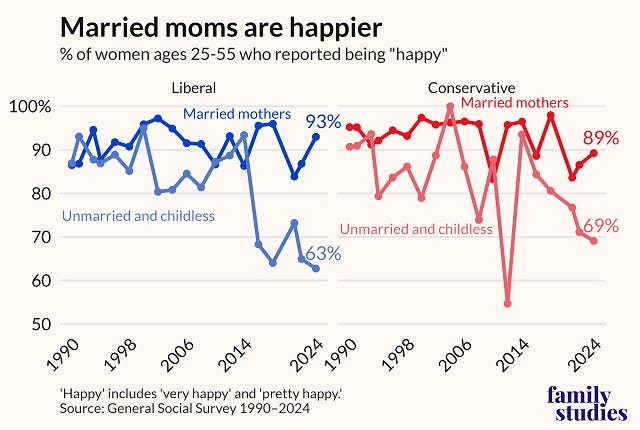
Research recently released by the right-leaning Institute for Family Studies indicates that 93% of liberal married moms report being “happy” with their lives, making liberal married women the happiest demographic out there.3 Maybe those organized gangs of wine moms aren’t so miserable after all.
Eli J Finkel’s concept of the “All or Nothing Marriage” offers a useful framework for understanding changing marriage trends. In my last post, I talked about our K-shaped economy, and marriage these days is K-shaped too. Good marriages are better than ever—more companionate, egalitarian, intimate, and rewarding—but there is a widening gap between great marriages and average marriages, and more people are simply opting out of marriage because it feels aspirational and unattainable. You could argue that feminism raised the quality of marriage because it raised women’s status in a way that created more mutual respect and mutual reward, but it also made marriage more challenging to pull off, because you’ve got two people with equal status rather than one person whose identity subsumes the other.
The “some feminism” problem comes up here too. What’s best for marriage may be either a society with no feminism (women have no choice but to get married because their financial security depends on a husband) or a lot of feminism (women marry men who value them as full partners and respect their contributions), but when we go halfway and land on some feminism, it means that women are participating fully in the workforce while their partners aren’t participating fully in the home. I think that explains why the U.S. divorce rate peaked in the early ‘80s: women and men who’d grown up in a pre-feminist world were trying to reconcile women’s huge workforce gains with a culture that hadn’t quite caught up. Arlie Hochschild’s 1989 book, The Second Shift, captured that dynamic and is still relevant today, although many men have increased their housework and childcare contributions in the decades since.
Here’s where I land: We humans are social animals, and we struggle in isolation. Family formation matters. There are valid alternatives to the traditional nuclear family, but rather than disparage marriage and childrearing, I’d rather see a feminist movement that celebrates the rewards of family life and seeks to make those rewards more accessible to everyone. Children are wonderful, it takes a lot of work to raise them, and societies should use all the resources at their disposal to support that work and the people who do it, including mothers, fathers, childcare workers, teachers, and aunties. We can call that message feminist, we can call it humanist, but let’s not cede family values to the folks seeking to roll back the clock on women’s progress.
I was going to write that I feel sheepish about sharing them, but that’s too much punning for everyone except my dad.
Lyman Stone might disagree with me; he argues that South Korean men have “surprisingly normal” gender attitudes, but also shows data indicating that, in his words, “Korean men do less housework than married men… anywhere!” That’s partially a function of smaller houses and families and more outsourcing.
As I griped in a Note about this IFS report, it’s framed on their website in “gotcha” terms as a salvo against liberal women, even though the findings indicate that liberal married women are doing just fine.
Part III: Has feminism damaged boys and branded men as toxic?
Welcome to Part III of my mini-series on feminism and men. Part I focused on economics - whether women’s entry into the workforce has depressed men’s earnings and employment prospects and increased inflation. Part II was about family formation - whether feminism caused dropping birth and marriage rates by slagging nice normal families. Today I’ll focus more on culture, specifically education, male mental health, and misandry. Spoiler alert about misandry,
Claim: Feminists have made schools hostile to boys and spread the message that normal masculinity is “toxic” and wrong.
In 6th grade, my son had a teacher who was no fan of boys. She organized a “Girl Power” club, but when my son argued in favor of “boy power” in class, he got in trouble and we had to hold a special parent-teacher conference.
I don’t know whether this teacher identified as a feminist, but it’s likely true that the feminization of education has had negative consequences for boys. In 1960, about a third of public school teachers were male; now the percentage is a little below 25%, and only about 11% of elementary school teachers are men. Full disclosure, my husband and I are seriously considering sending our son to an all-boys school for high school, in part so that he can soak up more positive male influences. Needless to say, female teachers can and do provide excellent educations to both male and female students, but there is value to having men in teaching, mentoring, and coaching roles where they can serve as role models for boys.
Of course, feminists aren’t barring men from careers in education. Men themselves are self-selecting out. You could argue that it’s because too many ladies in the teacher’s lounge have created bad vibes for men, but my hunch is that the real reason is that we underpay and undervalue teachers, and men continue to feel breadwinner pressure that pushes them into higher-earning careers. In fact, if you look at countries with the most male teachers, they overlap with countries that offer high teacher pay and a steeper rate of salary growth - places like Luxembourg, Japan, Germany, and Switzerland. Luxembourg is the country that comes closer to 50-50 representation - 46% of secondary school teachers are male - and probably not coincidentally, offers the highest teacher salaries in the world. If we’re serious about fixing education, let’s raise teacher pay! Any society that centers the welfare of children should be pulling out all the stops to make teaching a desirable and prestigious job, one that appeals to talented young people of both genders.
In addition to the declining representation of male teachers, education has also changed over the last half-century in ways that are bad for boys (and active, out-of-the-box girls, too). When I was in kindergarten in the 1980s, we lay on a mat for nap time in the middle of the day, we played with clay, we sang the alphabet song, and we learned basic math with manipulatives (wooden blocks). Now, not only has kindergarten gotten more structured and academic, but even preschools have kids doing worksheets and learning to sound out words. I’ve posted before about how my son got kicked out of one preschool for “playing too much.”
Education changed dramatically in part because of the Bush Administration’s 2001 No Child Left Behind law, which made standardized testing a cornerstone of public education and tied school funding to student test scores, reducing teacher autonomy over curricula and incentivizing teachers to “teach to the test.” NCLB was replaced in 2015 by the Every Student Succeeds Act, which softened federal oversight, but the effects on schools have lingered. In order to make room for more academics, many schools have cut music, art, and recess, and even shaved down the time that kids get to eat lunch. In addition to more test-oriented schools, another recent development is the rise of technology in classrooms, often pushed by EdTech companies with a profit motive. Kids are spending more time on screens and less time in physical play and socializing. This privileging of seated desk work over free play is particularly disadvantageous to boys, who mature more slowly than girls and seek out more vigorous physical activity. The fact that 15% of school-aged boys have a diagnosis of ADHD points to a real mismatch between school environments and boys’ learning needs.
Boys are falling behind at the college level, too. In fact, it’s now easier to get into college if you’re male because girls apply to universities at higher rates and have better high school grades. Again, it’s not clear that feminists are pushing boys out of universities, but rather that boys themselves are self-selecting out, in part because of growing political polarization around the value of higher education. As the figure below shows, right-leaning high school boys are more likely to express disinterest in college than any other group. Given that a college degree is still a solid predictor of lifetime earnings, anti-college attitudes may put conservative young men at a disadvantage. It might also make it hard for them to marry and form families, given that women typically seek out men with comparable educational attainment. Indeed, as I talked about last week, marriage rates have dropped the most among the non-college-educated.
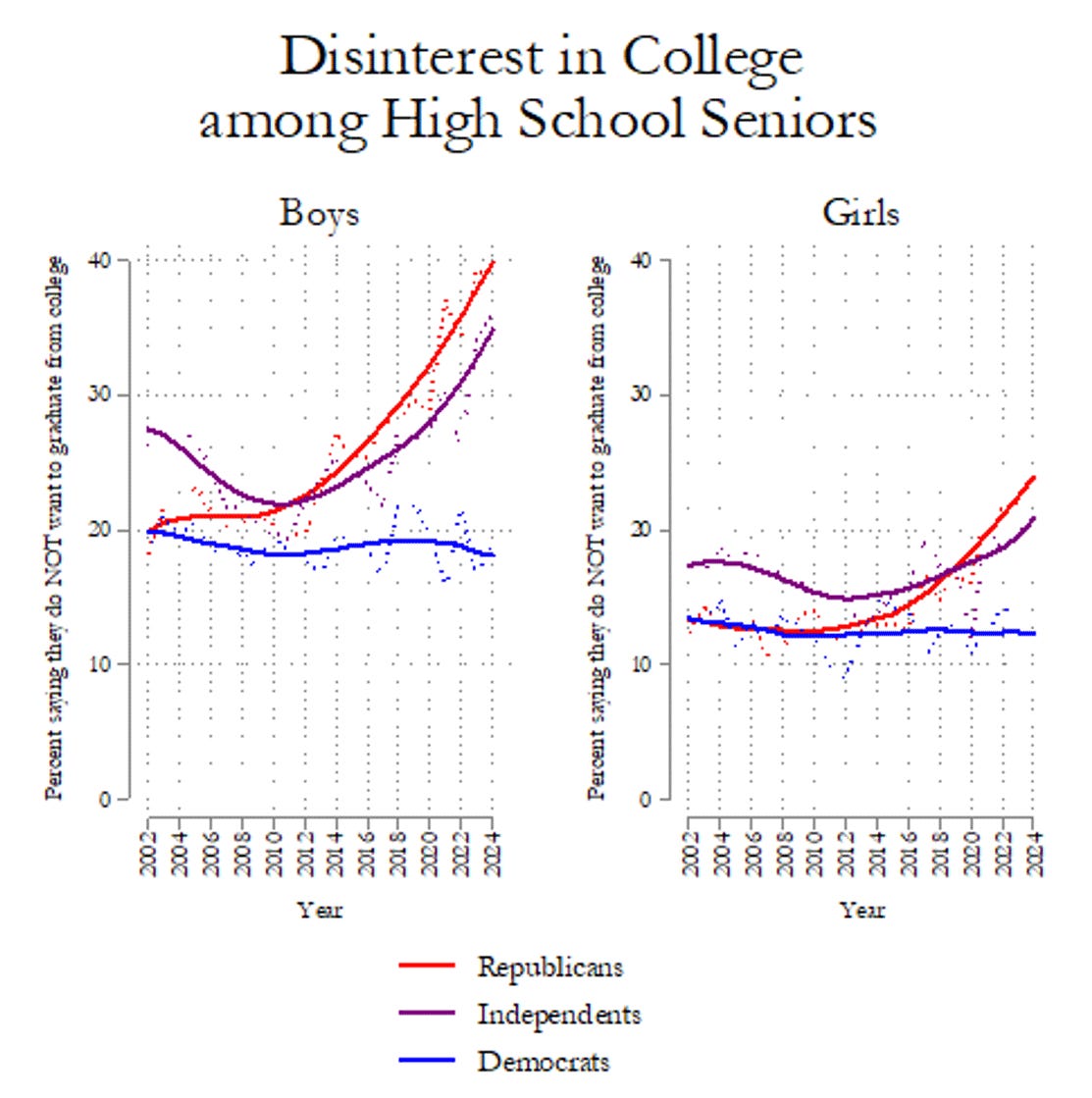
Source: Monitoring the Future: A Continuing Study of American Youth (12th Grade Survey), 2002-2024
Claim: Boys and men are struggling emotionally, and feminists don’t care.
Young men are having a tough time. You’ve likely heard about the “male loneliness crisis” and seen alarming statistics suggesting that young men report having few close friends, feel isolated, and are devoting time to antisocial hobbies (video-gaming, sports betting) instead of socializing, dating and pursuing work or education.
But there’s mounting evidence that the male loneliness crisis is really a youth loneliness crisis. Young women are struggling too. In an analysis of national survey data collected from over 4,500 individuals over three waves, Lakshya Jain finds that the loneliness crisis has been “over-gendered.” As he writes, “You can find column after column on the male loneliness epidemic. But when it comes to the female loneliness epidemic? Crickets.” But, he finds, “When you look at the data, the “antisocial crisis,” as I like to call it, is actually most pronounced among young women, who experience the highest rates of social isolation.” Indeed, he writes, “Age, not gender, shows far greater correlation with antisocial attitudes and beliefs. Younger voters — both male and female — are increasingly paralyzed by anxiety and fear, and they are finding it harder and harder to socialize.”
Research from Richard V Reeves’s group, the American Institute for Boys and Men, paints a similar picture. In an analysis of American Time Use Study data, they conclude, “We find that people are indeed spending more time alone than they were 20 years ago, but the trend has been similar for both men and women. On broad measures such as overall loneliness, satisfaction with emotional support, number of close friends, and time spent alone, men and women look similar.” Indeed, their takeaway is similar to Jain’s —young women are actually worse off: “If anything, it is young women that report feeling particularly lonely right now.”
Rather than blaming gender dynamics for male despair, both Jain’s essay and AIBM’s analysis point to a more likely culprit: the internet, which has reduced in-person socializing, and which has evolved to capture attention through upsetting and enraging content (more on that in a minute). I’d also cite our highly mobile society, which has weakened intergenerationl networks, and our built environment, which increasingly lacks the ‘third spaces’ that facilitate interaction.
As to whether or not feminists care about men’s well-being, I think the answer here is a mixed bag. It’s true that some feminist voices have advocated for sole attention to women’s interests, as an effort to rebalance the historical scales, and have downplayed men’s concerns as a result. But it’s also true that many feminists have expressed concern about male mental health. In a series of major donations earmarked for gender-equity causes, Melinda French Gates designated $20M apiece for two groups focusing specifically on boys and men, the aforementioned AIBM and the organization Equimundo.
Many feminist writers have argued that sexism and prescriptive gender roles are damaging to boys as well as to girls. As an example, influential feminist theorist bell hooks wrote extensively and compassionately about the psychological health of young men. She contended that, by pushing rigid expectations of masculinity on boys, patriarchal systems constrain their ability to freely express their true selves. As she wrote, “To indoctrinate boys into the rules of patriarchy, we force them to feel pain and to deny their feelings.” Her conclusion: “Boys need healthy self-esteem. They need love.”
But what about misandry? There are feminists who really just hate men.
In 1967, Valerie Solanas published the SCUM Manifesto, which advocated for “eliminating” men. Solanas was a paranoid schizophrenic who spent most of her life in mental institutions after trying to shoot Andy Warhol, but SCUM lingers as an exemplar of a certain kind of radical feminism that makes a throughline into Riot Grrl culture and the rhetoric that can still be found within certain corners of the internet.
Personally I put SCUM and other femcel effluvia into a similar mental basket as Sex Pistols lyrics like, “I am the Antichrist…I want to destroy passerby”—a deliberately provocative and even satirical relic, not a serious policy document that seeks to meaningfully shift our material lives. Still, I get why men don’t like a manifesto that says they should all disappear! You could argue that there’s a difference between “punching down” and “punching up” when it comes to power dynamics, but that doesn’t excuse blanket attacks on a whole gender.
It’s true that there is often less overt chastising of misandrist rhetoric that comes from women than misogynistic rhetoric coming from men. As an example, Virginia Weaver, a reformed misandrist, discovered that she received little pushback to her anti-men rhetoric: “I was open about my prejudice too!…And I received praise for my misandry. People in liberal spaces, wherein I tend to move, ate it up.“ Weaver suspects that the pendulum is swinging on tolerance of misandry: “Even in left-wing spaces, I think casual-but-intense misandry has become less trendy.” That’s a good thing.
In an essay on what it’s like to be a man married to a feminist, couples therapist John Williams PhD makes a useful distinction between real feminism and online “outrage culture.” As he writes, “Given the digital, performative, and often amplified nature of the current moment, this has to be said: not everything that calls itself feminism is. Some of it is just vitriol in feminist drag: rhetoric that reflects neither feminist values nor feminist goals.”
Indeed, although Solanas-style misandry has been a feature of feminism since its early days, online discourse has a uniquely powerful ability to amp up bad feelings and polarize the genders. A few weeks ago, NYU social psychologist Jay Van Bavel came to visit my university and gave a talk that is still living rent-free in my brain. He presented research on the difference between political discourse in real life and political discourse online. In real life, people’s beliefs are usually distributed along a bell curve, with most people expressing pretty moderate opinions. But the folks who engage the most in online political discourse are at the most extreme ends of belief on any given issue area. As his research group writes, “False norms emerge, in part, because social media is dominated by a small number of extreme people who post only their most extreme opinions, and do so at a very high volume…while more moderate or neutral opinions are practically invisible online….Indeed, 97 % of political posts from Twitter/X come from just 10 % of the most active users on social media, meaning that about 90% of the population’s political opinions are being represented by less than 3% of tweets online.” As a result, you end up with a U shaped distribution rather than a bell, where extreme folks are hugely overrepresented and moderate folks are the least represented. This, to me, explains a LOT about the vibes online, and why gender polarization seems to be on the rise.
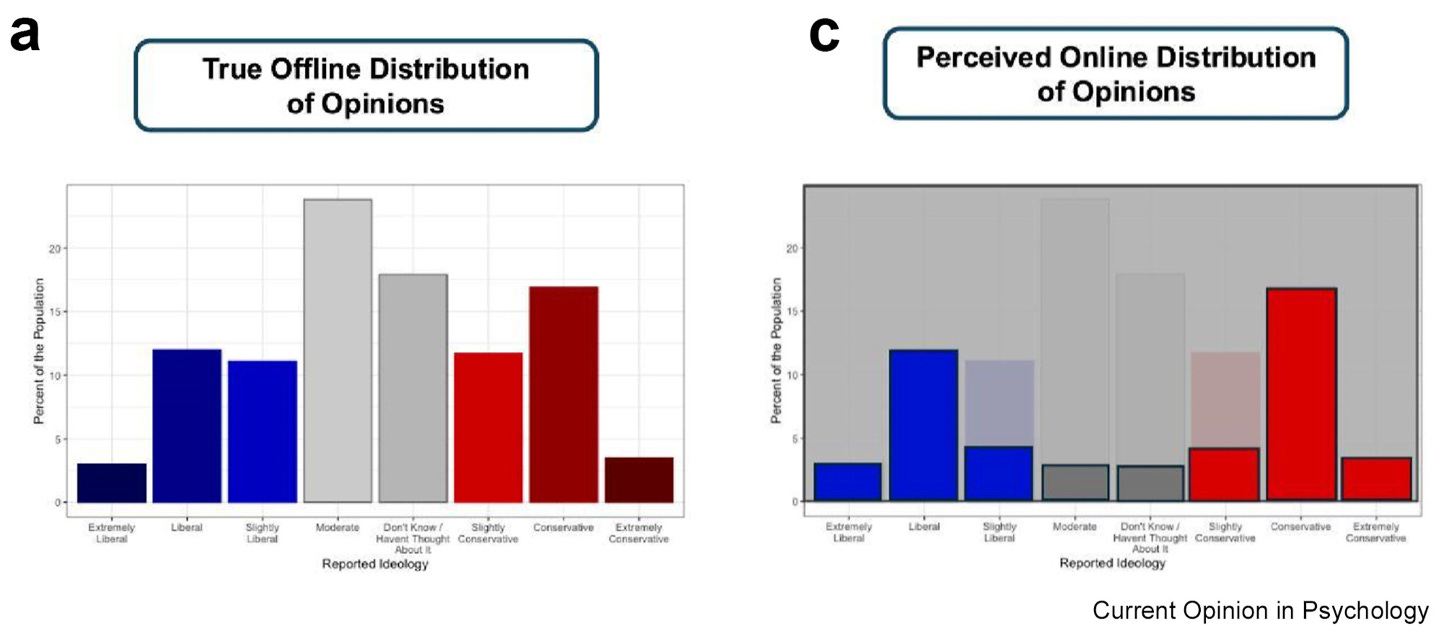
Here’s what happens to the distribution of opinions online when moderate views are downgraded by rage-baity algorithms. Source: Robertson, C. E., Del Rosario, K. S., & Van Bavel, J. J. (2024). Inside the funhouse mirror factory: How social media distorts perceptions of norms. Current Opinion in Psychology, 60, 101918.
My own litmus test when evaluating heated discourse of any stripe is to ask, Is this sentiment being expressed by someone who is wielding real-world power and authority to advance feminist goals, or by someone who is seeking clicks? That is, is this about a piece of legislation that, say, improves maternal healthcare, or is it about getting mad on social media? I take the latter, the “vitriol in feminist drag,” with a big grain of salt.
In any case: If it’s not already obvious, let me be clear about where I stand on reflexively anti-male rhetoric within feminism. It’s bad. I don’t like it. I think it’s counterproductive and hurts the feminist cause more than it helps it.
In an essay on how Democrats should course-correct on young men, LastBlueDog notes that progressive policies have the potential to deliver good outcomes for young men, but the vibes are off, because many men feel discarded or dismissed within left-leaning spaces. Although I don’t agree with every word in his essay, I do agree with this point. I also agree with his conclusion: “The only real path forward for the left is a return to universalism stripped of explicit identitarian politics. We succeed or fail as a nation, and one of the greatest forces for forward progress in human history has been the ambition and drive of young men to prove their worth in the world.”
But if self-proclaimed feminists are hurting the movement’s credibility by man-bashing online, why have feminism at all?
Good question! As Kennedy N commented on Part I of this series, “Feminism does seem to have a PR problem.” He described a survey that asked people from seven European countries plus the USA if they identified as a feminist. Endorsement ranged from 15%-48%. When asked instead, “Do you think men and women should/should not have equal rights and status in society, and be treated equally?”, 74% to 91%. of respondents said yes. Some respondents saw a third question: “One definition of a feminist is someone who thinks men and women should have equal rights and status in society, and be treated equally. Are you a feminist?” Endorsement dropped to between 45%-77%. As Kennedy writes, “This suggests there is something about the word itself. Most people are not the kind of “weirdos” who read long explainer articles. They hear feminism and effectively switch off.”
Given this bad branding, why not just discard the word “feminist” and go with something that has more mainstream appeal, like “humanist”? Personally, I think it’s still worth holding onto a word that reflects one of the most successful and transformative social movements of our time. It used to be taken completely for granted (and still is, in some parts of the world) that women were fundamentally biologically inferior to men and should play subservient roles in society. Globally, women continue to fall behind men on many metrics that matter. There are countries in which women still require their husband’s permission to work, travel, or own property. But in the countries where feminism has succeeded, it has clearly brought greater freedom and prosperity to both men and women.
The folks advocating for “humanist” do have one good point, though: Men and women rise and fall together. Most women and girls share their households with men and boys, and the political, social, and economic interests of the sexes are aligned, not at odds. We lift each others’ boats. Men can and do play a role in building a better, more fair, more just, and more equitable world. We women need them, just as they need us.
Note: Reprinted with permission from Darby Saxbe’s Substack, Natal Gazing.