
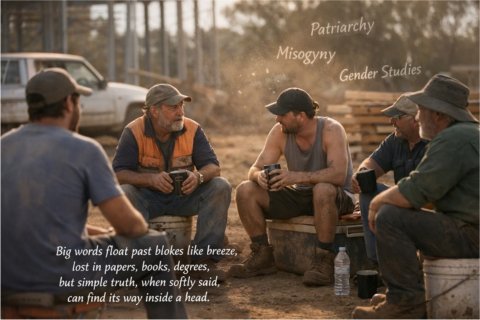
It was a smoko break on a job site just outside town. Dust in the air, steel frames going up, utes parked in a rough line like they had been dropped there by habit more than design.
A few of the boys were sitting on upturned buckets, boots off, socks half rolled, mugs of tea going lukewarm. Good men, solid workers, the kind who turn up early and stay late without making a fuss.
I had been invited along by a mate who thought I might “have a bit to say” to the crew. That usually means tread lightly. I immediately warmed to the idea because although I’d been to university, undertaken personal growth and gender studies, there was also a time in my life when I worked as a concreter; a time when my peer group was builders and labourers.
We started with the usual. Footy, weather, a bit of banter about who had the worst boss. Then the conversation drifted, as it sometimes does, to relationships. A bloke in his twenties shrugged and said, “Women just don’t get us, mate.”
There were nods of agreement. A few laughs. Nothing aggressive, just a quiet, shared confusion.
So I asked a simple question. “Have you ever heard the word patriarchy?”
Blank looks.
“What about the term misogyny?”
One of the older blokes scratched his head. “Is that something to do with politics?”
They were not stupid. Far from it. These were capable, practical men who could build a house from the ground up, fix an engine by ear, and read the weather better than any app. But the language of gender, the language used in universities and policy papers, had never really reached them.
And yet, they were living inside it; inside the patriarchy.
I did not launch into a lecture. That would have lost them in seconds. Instead, I told a story about a rafting trip years ago, a group of young men trying to outdo each other, pushing harder, louder, rougher, until one of them nearly got hurt.
We sat with it for a moment. Letting it soak in.
I tried again, this time without the labels.
“Ever felt like you’ve got to be tough all the time, even when you’re not?”
Every head nodded.
“Ever held something in because you thought you’d get hammered for saying it out loud?”
More nods. A few quiet “yeahs.”
So I kept it simple and offered them this; moving slowly like a rap artist while I read.
Big words float past blokes like breeze,
lost in papers, books, degrees,
but simple truth, when softly said,
can find its way inside a bloke’s head.
More nods. Someone said, “yeah, those big words.
Then I continued; “Ever said something about a woman you didn’t really believe, just to fit in?”
That one landed; hard. A couple of blokes looked down at their boots.
I said, “There’s a whole system behind that. Some people call it patriarchy. It’s just a set of old rules about how men should be and how women should be treated. The problem is that those outdated rules can hurt both.”
No one argued and no one needed convincing. I sensed they were already recognising it in themselves in.
Another bloke spoke up. “So what do you do about it?”
“That’s a good question,” I said.
I continued by saying, “It does not start with big speeches or perfect behaviour. It starts small. Calling out a mate, respectfully. Listening a bit more. Dropping the act when it does not serve you. Letting a different kind of strength show up.”
We talked for another half hour. There was nothing dramatic; nor any breakthroughs you could measure. Just a shift, like a small change in current you only notice if you are paying attention.
As I left, one of the younger guys came over.
“Never heard those words before,” he said, “but I reckon I know what you mean.”
That was enough.
Because the truth is, we do not need every man and boy to become a gender studies expert. But we do need them to feel what is going on beneath the surface, and to see that there is another way to be.
Sometimes all it takes is the right moment, a bit of respect, and a few simple words that actually land.