
Yesterday, two things happened that made me empathize with boys and men who are drawn to the manosphere.
The first was that I had a friend – who I’ll refer by the pseudonym Hayden, for his privacy – disclose an instance of sexual harassment that happened to him in a place where he normally feels very safe.
The second was that a staff member at a residential therapy program for children who have been sexually abused told me that they have had multiple boys come through their program who idolize manosphere influencers like Andrew Tate.
Though my friend Hayden absolutely doesn’t ascribe to male supremacist beliefs, I see these two things as connected, and these two experiences had me reflect on the life circumstances that might lead some men and boys toward manosphere spaces and figures.
Let me explain why.
Hayden’s Experience
*Hayden gave me permission to share this story.*
My friend Hayden frequently visits his local community centre where he works out and swims.
Yesterday, while he was sitting in the hot tub, he noticed a man who was staring at him.
The man would look away periodically, but then also started moving closer to where Hayden was sitting. When Hayden left to visit the steam room, this man followed and entered the steam room, and then sat beside him. Hayden moved, the man followed. This man went so far as to follow Hayden to the washroom, stand at the urinal right beside him (despite other free urinals in the space), and stare at him some more.
When he explained this situation to me, Hayden said he felt extremely uncomfortable, and afraid.
He shared that he had no idea how far this man’s behaviour would escalate: would the man assault him? Follow him home? Ambush him and sexually assault him? He was understandably scared. We have no way of knowing someone’s intentions.
As it was happening, Hayden debated telling a staff member at the rec centre, but was hesitant.
“Am I over-reacting? What if it’s not as bad as I am making it out to be?”
“What if they don’t believe me? Or what if they believe me, but don’t take it seriously?”
“These lifeguards are all younger than me, what are they going to do about it? Am I expecting a lot from people who are practically teenagers?”
Thankfully, the man left with no further escalation; a huge relief.
Hayden, despite his fears about not being believed, did choose to tell the staff at the front desk of the rec centre before he went home. To their immense credit, the staff took it seriously.
I am incredibly proud of my friend’s courage, and grateful that he was met with support.
Emotional Reactions to Sexual Violence
When Hayden disclosed his experience to me, our conversation included familiar emotions that many people who have experienced sexual violence feel: doubt, confusion, shame, self-blame, a need to take back control, and a desire for safety.
Some of the things he said to me absolutely broke my heart:
“How could this happen to me, as a man?”
“What more should I have done?”
“I am ashamed that I could feel so scared, despite having training in self-defense.”
“Why couldn’t I have done more to not feel so uncomfortable?”
Of course, I felt it was important to offer validation for the fear. No matter our training, that’s our nervous system warning us about threats.
I also reiterated that what happened to him was not his fault or his responsibility to “better manage”. Someone else was choosing to act that way toward him – that’s on them.
I can only imagine the boys at the residential therapy program for sexually abused children also experience the same emotions as Hayden, and likely more intensely, for longer, and with less coping skills – just by virtue of their age and circumstances.
Children who experience sexual abuse go through an intense array of emotional responses. Doubt, confusion, shame, self-blame, a need to take back control, and a desire for safety are likely very common for them, just as they were for Hayden.
I am willing to guess that those intense and confusing emotions can lead boys and men straight into the arms of Tate-like influencers.
How could Sexual Abuse lead Boys and Men to the Manosphere?
When the sexual abuse therapy program staff told me that they had supported a number of boys who idolized manosphere influencers like Andrew Tate, my first reaction was confusion.
It was the sheer cognitive dissonance of it all: the boys are in this program because they were sexually abused, why on earth would they ever trust or look up to someone who sexually abuses others?
Andrew Tate, for anyone who is unaware, has been accused and charged with multiple counts of sexual assault and sex trafficking.
However, it didn’t take long for an answer – or at least a partial explanation – to surface.
These boys had experienced an extreme violation. We know that statistically, most boys are sexually abused by men. Often these are men in positions of trust or authority. It is rare that these men are strangers – most often, they are people that these boys know (89% of the time, according to the Government of Canada).
These boys are already experiencing profound cognitive dissonance – the kind that arises from having been abused at the hands of someone who should have been safe.
Like Hayden did, they search for answers – as well as for safety.
They might want to take back control that they feel was taken from them. They might want to figure out how to better protect themselves — despite, of course, the reality that what happened to them was not their fault. The harm, violation, and loss of autonomy can be so viscerally felt in instances of sexual abuse and assault.
Maybe for some boys who have experienced sexual abuse, their need for safety and protection translates to a desire to feel powerful. Maybe they want to be strong, independent, or appear invulnerable.
Maybe some of them want to do whatever it takes to not be seen as a target for abuse again. And perhaps most of this is subconscious.
And then there, in the manosphere, are men who sell that exact power fantasy.
This fantasy includes never doubting yourself (you are always right), shamelessness (do whatever you want), a black-and-white worldview (the strong vs the weak), defense of dominance and aggression (might makes right), steps to achieve stability (follow my program and become successful), independence (you can be independently wealthy; guys like us don’t need others), simple revenge fantasies (do this and you will get the girl, rise above your bullies, etc)... of course with heavy-handed misogyny, homophobia, transphobia baked in.
But perhaps most importantly for young men, especially young men who have experienced abuse, is the promise of safety: "if you become strong like me, no one will ever be able to hurt you again".
I can see why boys and men who have experienced abuse – sexual or otherwise – might be drawn to such false promises.
Turns out, there is some evidence of a higher prevalence of experiences of abuse among those who are drawn to extremist belief systems.
Below, I compare prevalence of abuse data from the general population with the data from a study on former white supremacists. (I know that not all manosphere guys are white supremacists, but the point I’m making is about the appeal of extremist beliefs to abuse survivors, and male supremacist beliefs are part of white supremacists’ worldviews anyways – bear with me, data is currently a bit limited on manosphere adherents — but if any researchers reading this have better data, please tell me!).
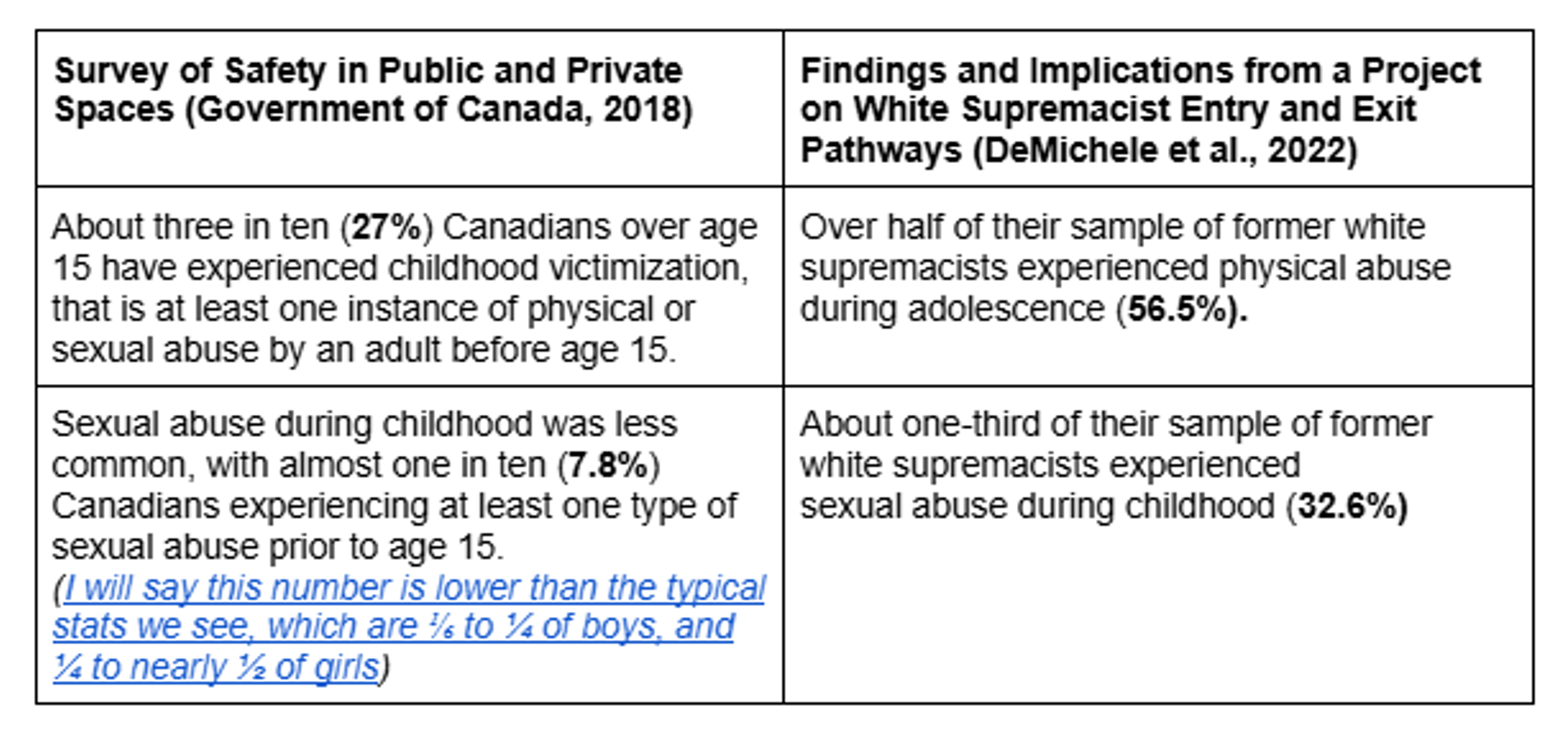
I’m definitely not the only person to think about this – and thankfully, some actual researchers have looked into it.
Zoe Marchment and colleagues (2025) ran a survey-based study using a nationally representative sample of the UK population to explore correlations among different ACEs (Adverse Childhood Experiences) and susceptibility to violent extremism.
They found that experiencing adverse childhood experiences – in other words, childhood trauma – is related to an increased susceptibility to violent extremist beliefs.
They theorized a bit about why this might be the case.
First, young people who experience violence at the hands of their caregivers are provided a script of how to use violence to control others. Though of course it’s very important to reiterate that many youth who experience violence will NOT inevitably one day also perpetrate it.
But it’s not just a question of learning behaviour, it’s also the underlying search for safety. “If I am like this [violent, intimidating, etc.], maybe no one will ever hurt me again”.
As the researchers describe:
“Those who experience ACEs can often develop negative schemas about the self and environment, viewing themselves as helpless and/or powerless, and viewing the world as an unpredictable and dangerous place. An unstable home environment may cause an individual to view the world as equally unstable and unpredictable — this is susceptibility to violent extremism. This may lead them to pursue different environments outside of the home and find refuge among other groups, for example peers who reinforce criminal conduct or expose them to extremist viewpoints — leading to vulnerability to violent extremism. However, further work would be required to test this theoretical link”. – Marchment et al., 2025
Empathy for the Boys and Men Drawn to the Manosphere
If you’ve made it this far, thank you for sticking with me.
I want to make a few last points, and I hope these may resonate.
First, it’s worth stating outright that the manosphere is by and large extremely harmful. It’s harmful to girls, women, and sexually/ gender-diverse people. It’s also harmful to men and boys. And while we can recognize its immensely harmful nature, we could also recognize that it’s a place that some boys and men might be drawn to due to experiences of trauma and abuse.
Second, the influencers within the manosphere are to blame for harms they cause by spewing hateful and harmful ideology, including normalizing, instructing, or inciting violence. Boys and men who adopt the rhetoric of the manosphere and proceed to enact harm on others also need to be accountable for their actions.
Third, to anyone who feels that they do not owe radicalized men and boys their empathy – you’re right. You don’t. I would never tell someone that they must extend their emotional labour to someone else. Your energy is yours to expend as you wish, and that’s how it should be.
At the same time, I invite anyone who is willing or able to extend their empathy to the boys and men who are drawn to the manosphere. Because my fourth point is that I think a big part of fighting the manosphere needs to be focused on healing for men and boys.
Is it possible that at least some of the boys and men drawn to manosphere messaging have experienced abuse, including childhood sexual abuse? Yes, and in fact, more than possible, it seems highly probable.
And for how many of these boys and men do the messages of the manosphere have particular appeal because they are looking for ways to keep themselves safe in an unsafe world? (Even if their strategy is deeply flawed and won’t work, and potentially harms others).
How many manosphere-influenced boys are in cages – partly socially-created by patriarchal gender norms, and partly as a trauma response – and have been busy reinforcing the bars with manosphere beliefs? They want to keep themselves safe, but they are also keeping themselves trapped.
Perhaps fifth, then – it bears repeating that empathy is not endorsement. Empathy for the experiences of men and boys does not mean endorsement of harmful male supremacist beliefs or behaviours.
What it does mean is understanding what might draw them to manosphere spaces – including their emotions, needs, and experiences. Whether it’s a search for safety, competence, or clarity, we need to understand what needs might be met within manosphere spaces. That understanding – that empathy – is crucial in our efforts to offer alternative (and healthy!) messaging and spaces. Thankfully, there are great people already doing this work.
There are many many pieces to the puzzle of gender-based violence prevention and the prevention of violent extremism. One of these puzzle pieces is the prevention of child abuse. Another piece is healing for victims and survivors, which of course includes boys and men. Once again, thankfully, there are some truly great programs and practitioners across the world who are working hard to prevent and respond to abuse and trauma — and it needs to be recognized that this work has long been (and is still) led by women.
In thinking about my friend Hayden today, I know he will be okay. He has a well of internal strength and many people who love and support him.
As for the boys at the centre, they are also getting help to heal, with a dedicated team of caring professionals to support them.
I hope that every boy or man who is drawn to the manosphere can likewise receive help to heal from whatever is hurting them.